In Saw Did Gordon Ever Get to See Family Again
| Gordon Cooper | |
|---|---|
 | |
| Built-in | Leroy Gordon Cooper Jr. (1927-03-06)March 6, 1927 Shawnee, Oklahoma, U.Due south. |
| Died | October iv, 2004(2004-10-04) (aged 77) Ventura, California, U.Due south. |
| Alma mater |
|
| Occupation | Exam pilot |
| Awards |
|
| Space career | |
| NASA astronaut | |
| Rank | Colonel, USAF |
| Fourth dimension in space | 9d 09h 14m |
| Selection | 1959 NASA Group i |
| Missions | Mercury-Atlas nine, Gemini 5 |
| Mission insignia |   |
| Retirement | July 31, 1970 |
Leroy Gordon "Gordo" Cooper Jr. (March half-dozen, 1927 – Oct iv, 2004) was an American aerospace engineer, test pilot, United states of america Air Force pilot, and the youngest of the 7 original astronauts in Project Mercury, the first human being space program of the United States. Cooper learned to fly as a kid, and afterwards service in the United States Marine Corps during World War II, he was deputed into the United states Air Strength in 1949. After service as a fighter pilot, he qualified as a test airplane pilot in 1956, and was selected as an astronaut in 1959.
In 1963 Cooper piloted the longest and last Mercury spaceflight, Mercury-Atlas 9. During that 34-60 minutes mission he became the start American to spend an entire day in infinite, the first to sleep in infinite, and the terminal American launched on an entirely solo orbital mission. Despite a series of severe equipment failures, he managed to successfully complete the mission under manual control, guiding his spacecraft, which he named Organized religion seven, to a splashdown just 4 miles (6.4 km) ahead of the recovery send. Cooper became the first astronaut to make a second orbital flight when he flew as Command Airplane pilot of Gemini 5 in 1965. Along with Pilot Pete Conrad, he set a new space endurance record by traveling 3,312,993 miles (5,331,745 km) in 190 hours and 56 minutes—only short of eight days—showing that astronauts could survive in infinite for the length of time necessary to go from the Globe to the Moon and back.
Cooper liked to race cars and boats, and entered the $28,000 Salton City 500 miles (800 km) boat race, and the Southwest Championship Drag Boat races in 1965, and the 1967 Orangish Bowl Regatta with fire fighter Red Adair. In 1968, he entered the 24 Hours of Daytona, but NASA direction ordered him to withdraw due to the dangers involved. Later on serving every bit backup commander of the Apollo ten mission, he was superseded by Alan Shepard, and retired from NASA and the Air Force with the rank of colonel in 1970.
Early life and education [edit]
Leroy Gordon Cooper Jr. was born on March half dozen, 1927, in Shawnee, Oklahoma,[1] the only child of Leroy Gordon Cooper Sr. and his married woman Hattie Lee née Herd.[ii] His mother was a school instructor. His begetter enlisted in the United states of america Navy during Earth War I, and served on the presidential yacht USSMayflower. After the war, Cooper Sr. completed his high school pedagogy; Hattie Lee was one of his teachers, although she was only two years older than him. He joined the Oklahoma National Guard, flying a Curtiss JN-4 biplane, despite never having formal military machine pilot training. He graduated from college and police force school, and became a state commune judge. He was called to active duty during World War II, and served in the Pacific theater in the Judge Advocate General'southward Corps.[three] He transferred to Us Air Force (USAF) after information technology was formed in 1947, and was stationed at Hickham Air Force Base, Hawaii Territory. He retired from the USAF with the rank of colonel in 1957.[4]
Cooper attended Jefferson Unproblematic School and Shawnee High School,[four] where he was on the football and track teams. During his senior high school year, he played at halfback in the land football game championship.[5] He was active in the Male child Scouts of America, where he achieved its second highest rank, Life Scout.[6] His parents owned a Command-Aire 3C3 biplane, and he learned to fly at a young historic period. He unofficially soloed when he was 12 years old, and earned his pilot'south license in a Piper J-3 Cub when he was sixteen.[4] [7] His family moved to Murray, Kentucky, when his father was called dorsum into service, and he graduated from Murray High Schoolhouse in June 1945.[2]
Afterward Cooper learned that the United States Regular army and Navy flight schools were not taking any more candidates, he enlisted in the United states of america Marine Corps.[5] He left for Parris Island as soon every bit he graduated from high schoolhouse,[two] merely World War II ended before he saw overseas service. He was assigned to the Naval University Preparatory School every bit an alternate for an appointment to the United states of america Naval Academy at Annapolis, Maryland, but the primary appointee was accustomed, and Cooper was assigned to baby-sit duty in Washington, D.C. He was serving with the Presidential Laurels Guard when he was discharged from the Marine Corps in 1946.[5]
Cooper went to Hawaii to live with his parents. He started attending the Academy of Hawaii, and bought his own J-3 Cub. There he met his first wife, Trudy B. Olson (1927–1994) of Seattle, through the local flying lodge. She was agile in flying, and would subsequently become the only married woman of a Mercury astronaut to have a private pilot license. They were married on Baronial 29, 1947, in Honolulu, when both were 20 years old. They had two daughters.[two] [iv] [8]
Military service [edit]

At college, Cooper was active in the Reserve Officers' Training Corps (ROTC),[8] which led to his being deputed as a second lieutenant in the U.S. Army in June 1949. He was able to transfer his commission to the U.s.a. Air Strength in September 1949.[ix] He received flight training at Perrin Air Force Base, Texas and Williams Air Force Base, Arizona,[4] in the T-6 Texan.[8]
On completion of his flight training in 1950, Cooper was posted to Landstuhl Air Base of operations, West Federal republic of germany, where he flew F-84 Thunderjets and F-86 Sabres for iv years. He became a flight commander of the 525th Fighter Bomber Squadron. While in Frg, he attended the European Extension of the University of Maryland. He returned to the United States in 1954, and studied for two years at the U.S. Air Force Institute of Technology (AFIT) in Ohio. He completed his Bachelor of Science degree in Aerospace Applied science there on August 28, 1956.[iv] [10]
While at AFIT, Cooper met Gus Grissom, a young man USAF officeholder, and the two became good friends. They were involved in an accident on takeoff from Lowry Field on June 23, 1956, when the Lockheed T-33 Cooper was piloting suddenly lost power. He aborted the takeoff, simply the landing gear collapsed and the shipping skidded erratically for ii,000 feet (610 m), and crashed at the end of the runway, bursting into flames. Cooper and Grissom escaped unscathed, although the aircraft was a total loss.[10]
Cooper and Grissom attended the USAF Experimental Flight Test Pilot School (Course 56D) at Edwards Air Force Base of operations in California in 1956.[10] After graduation Cooper was posted to the Flight Examination Engineering Division at Edwards, where he served as a test airplane pilot and project manager testing the F-102A and F-106B.[2] He likewise flew the T-28, T-37, F-86, F-100 and F-104.[xi] By the time he left Edwards, he had logged more than 2,000 hours of flight time, of which i,600 hours were in jet aircraft.[10]
NASA career [edit]
Projection Mercury [edit]

In January 1959, Cooper received unexpected orders to study to Washington, D.C. There was no indication what it was nearly, but his commanding officer, Major General Marcus F. Cooper (no relation) recalled an proclamation in the newspaper saying that a contract had been awarded to McDonnell Aircraft in St. Louis, Missouri, to build a space capsule, and advised Cooper non to volunteer for astronaut preparation. On February 2, 1959, Cooper attended a NASA briefing on Project Mercury and the part astronauts would play in it. Cooper went through the choice process with another 109 pilots,[12] and was non surprised when he was accepted as the youngest of the first vii American astronauts.[thirteen] [xiv]
During the selection interviews, Cooper had been asked about his domestic relationship, and had lied, saying that he and Trudy had a good, stable marriage. In fact, they had separated 4 months before, and she was living with their daughters in San Diego while he occupied a available's quarters at Edwards. Aware that NASA wanted to project an image of its astronauts as loving family unit men, and that his story would non stand up upward to scrutiny, he drove downward to San Diego to run across Trudy at the first opportunity. Lured by the prospect of a cracking take a chance for herself and her daughters, she agreed to proceed with the deception and pretend that they were a happily married couple.[xv]
The identities of the Mercury Seven were appear at a press briefing at Dolley Madison Business firm in Washington, D.C., on April 9, 1959:[16] Scott Carpenter, Gordon Cooper, John Glenn, Gus Grissom, Wally Schirra, Alan Shepard, and Deke Slayton.[17] Each was assigned a unlike portion of the projection forth with other special assignments. Cooper specialized in the Redstone rocket, which would exist used for the starting time, sub-orbital spaceflights.[18] He as well chaired the Emergency Egress Commission, responsible for working out emergency launch pad escape procedures,[19] and engaged Bo Randall to develop a personal survival knife for astronauts to carry.[20]
The astronauts drew their salaries as military officers, and an important component of that was flying pay. In Cooper'southward instance, information technology amounted to $145 a month (equivalent to $1,348 in 2021). NASA saw no reason to provide the astronauts with shipping, so they had to fly to meetings around the country on commercial airlines. To proceed earning their flight pay, Grissom and Slayton would go out on the weekend to Langley Air Forcefulness Base, and attempt to put in the required four hours a month, competing for T-33 aircraft with senior deskbound colonels and generals. Cooper traveled to McGhee Tyson Air National Baby-sit Base in Tennessee, where a friend let him fly higher-performance F-104B jets. This came up when Cooper had tiffin with William Hines, a reporter for The Washington Star, and was duly reported in the paper. Cooper and so discussed the issue with Congressman James G. Fulton. The matter was taken up past the House Commission on Science and Astronautics. Within weeks the astronauts had priority access to USAF F-102s, something that Cooper considered a "hot airplane", simply which could still take off from and land at brusque noncombatant airfields; only it did not brand Cooper popular with senior NASA management.[21] [22]
After General Motors executive Ed Cole presented Shepard with a make-new Chevrolet Corvette, Jim Rathmann, a racing automobile driver who won the Indianapolis 500 in 1960, and was a Chevrolet dealer in Melbourne, Florida, convinced Cole to turn this into an ongoing marketing entrada. Henceforth, astronauts would be able to lease brand-new Corvettes for a dollar a year. All of the Mercury 7 only Glenn shortly took up the offer. Cooper, Grissom and Shepard were shortly racing their Corvettes effectually Cape Canaveral, with the police ignoring their exploits. From a marketing perspective, it was very successful, and helped the highly priced Corvette get established as a desirable brand. Cooper held licenses with the Sports Car Lodge of America (SCCA) and the National Association for Stock Machine Auto Racing (NASCAR). He likewise enjoyed racing speedboats.[23] [24]
Cooper served every bit capsule communicator (CAPCOM) for NASA's first sub-orbital spaceflight, past Alan Shepard in Mercury-Redstone 3,[25] and Scott Carpenter'south orbital flight on Mercury-Atlas 7,[26] and was backup pilot for Wally Schirra in Mercury-Atlas 8.[four]
Mercury-Atlas 9 [edit]

Cooper was designated for the next mission, Mercury-Atlas nine (MA-9). Apart from the grounded Slayton, he was the only one of the Mercury Seven who had non even so flown in space. [27] [24] Cooper'southward option was publicly announced on November 14, 1962, with Shepard designated as his fill-in.[28]
Project Mercury had begun with a goal of ultimately flight an xviii-orbit, 27-hr mission, known as the manned 1-day mission.[29] On Nov 9, senior staff at the Manned Spacecraft Middle decided to fly a 22-orbit mission as MA-9. Projection Mercury still remained years behind the Soviet Wedlock'south infinite program, which had already flown a 64-orbit mission in Vostok three. When Atlas 130-D, the booster designated for MA-9, start emerged from the manufacturing plant in San Diego on January 30, 1963, it failed to laissez passer inspection and was returned to the factory.[30] For Schirra'southward MA-8 mission, xx modifications had been made to the Mercury spacecraft; for Cooper's MA-9, 183 changes were made.[30] [31] Cooper decided to proper name his spacecraft, Mercury Spacecraft No. 20, Organized religion 7. NASA public affairs officers could see the newspaper headlines if the spacecraft were lost at body of water: "NASA loses Faith".[32]
After an argument with NASA Deputy Administrator Walter C. Williams over final-minute changes to his force per unit area suit to insert a new medical probe, Cooper was nearly replaced by Shepard.[33] This was followed by Cooper buzzing Hangar S at Cape Canaveral in an F-102 and lighting the afterburner.[33] Williams told Slayton he was prepared to replace Cooper with Shepard. They decided not to, just not to allow Cooper know immediately. Instead, Slayton told Cooper that Williams was looking to basis whoever buzzed Hangar S.[34] According to Cooper, Slayton after told him that President John F. Kennedy had intervened to preclude his removal.[33]
Cooper was launched into space on May 15, 1963, aboard the Faith vii spacecraft, for what turned out to be the last of the Project Mercury missions. Considering MA-9 would orbit over almost every part of Earth from 33 degrees north to 33 degrees southward,[35] a total of 28 ships, 171 shipping, and eighteen,000 servicemen were assigned to support the mission.[35] He orbited the Earth 22 times and logged more time in space than all 5 previous Mercury astronauts combined: 34 hours, 19 minutes, and 49 seconds. Cooper accomplished an distance of 165.9 miles (267 km) at apogee. He was the first American astronaut to sleep, not merely in orbit,[2] [36] but on the launch pad during a inaugural.[37]

There were several mission-threatening technical problems toward the end of Faith 7 'southward flight. During the 19th orbit, the sheathing had a power failure. Carbon dioxide levels began ascension, both in Cooper's adjust and in the cabin, and the cabin temperature climbed to over 130 °F (54 °C). The clock and and then the gyroscopes failed, but the radio, which was continued directly to the battery, remained working, and allowed Cooper to communicate with the mission controllers.[38] Similar all Mercury flights, MA-ix was designed for fully automatic control, a controversial engineering determination which reduced the role of an astronaut to that of a passenger, and prompted Chuck Yeager to depict Mercury astronauts as "Spam in a can".[39] "This flying would put an stop to all that nonsense," Cooper subsequently wrote. "My electronics were shot and a pilot had the stick."[xl]
Turning to his agreement of star patterns, Cooper took manual command of the tiny capsule and successfully estimated the correct pitch for re-entry into the atmosphere.[41] Precision was needed in the calculation; modest errors in timing or orientation could produce large errors in the landing point. Cooper drew lines on the sheathing window to assistance him bank check his orientation before firing the re-entry rockets. "So I used my wrist watch for time," he later recalled, "my eyeballs out the window for mental attitude. Then I fired my retrorockets at the right time and landed right past the carrier."[42]
Organized religion vii splashed downwardly iv miles (six.four km) ahead of the recovery transport, the shipping carrier USSKearsarge. Religion 7 was hoisted on lath by a helicopter with Cooper still inside. One time on deck he used the explosive bolts to blow open up the hatch. Postflight inspections and analyses studied the causes and nature of the electric problems that had plagued the final hours of the flight, but no error was found with the operation of the pilot.[43]
On May 22, New York Metropolis gave Cooper a ticker-record parade witnessed past more than four 1000000 spectators. The parade concluded with a congratulatory dejeuner at the Waldorf-Astoria attended by 1,900 people, where dignitaries such equally Vice President Lyndon B. Johnson and former president Herbert Hoover made speeches honoring Cooper.[44]
Project Gemini [edit]
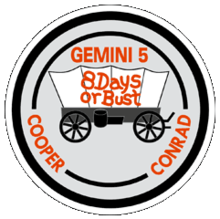
Cooper began the tradition of NASA mission insignia with this design for Gemini 5.
MA-ix was the last of the Project Mercury flights. Walt Williams and others wanted to follow upwards with a iii-day Mercury-Atlas 10 (MA-ten) mission, just NASA HQ had already announced that there would be no MA-10 if MA-ix was successful.[32] Shepard in particular was eager to wing the mission, for which he had been designated.[45] He even attempted to enlist the back up of President Kennedy.[46] An official decision that there would exist no MA-10 was made by NASA Administrator James E. Webb on June 22, 1963.[43] Had the mission been approved, Shepard might not have flown information technology, as he was grounded in Oct 1963,[47] and MA-10 might well accept been flown by Cooper, who was his backup.[45] In Jan 1964 the press reported that the Democratic Political party of Oklahoma discussed running Cooper for the United states of america Senate.[48]
Project Mercury was followed by Project Gemini, which took its proper name from the fact that it carried two men instead of but one.[49] Slayton designated Cooper as commander of Gemini v, an eight-day, 120-orbit mission.[47] Cooper's assignment was officially announced on February 8, 1965. Pete Conrad, one of the nine astronauts selected in 1962 was designated every bit his co-pilot, with Neil Armstrong and Elliot Encounter equally their respective backups. On July 22, Cooper and Conrad went through a rehearsal of a double launch of Gemini atop a Titan II booster from Launch Complex 19 and an Atlas-Agena target vehicle from Launch Complex 14. At the end of the successful examination, the erector could non be raised, and the two astronauts had to be retrieved with a scarlet picker, an escape device that Cooper had devised for Project Mercury and insisted be retained for Gemini.[50]

Cooper's wife Trudy watches the launch of Gemini five with their teenage daughters, Cam and Jan
Cooper and Conrad wanted to proper noun their spacecraft Lady Bird after Lady Bird Johnson, the First Lady of the United States, but Webb turned down their request; he wanted to "depersonalize" the infinite plan.[51] Cooper and Conrad then came up with the idea of a mission patch, similar to the organizational emblems worn by war machine units. The patch was intended to commemorate all the hundreds of people directly involved, not just the astronauts.[52] Cooper and Conrad chose an embroidered cloth patch sporting the names of the two crew members, a Conestoga railroad vehicle, and the slogan "viii Days or Bosom" which referred to the expected mission duration.[53] Webb ultimately canonical the design, but insisted on the removal of the slogan from the official version of the patch, feeling it placed too much accent on the mission length and not the experiments, and fearing the public might see the mission as a failure if it did not concluding the total duration. The patch was worn on the right breast of the astronauts' uniforms below their nameplates and contrary the NASA emblems worn on the left.[53] [54]
The mission was postponed from August 9 to 19 to requite Cooper and Conrad more than time to train, and was then delayed for two days due to a storm. Gemini v was launched at 09:00 on Baronial 21, 1965. The Titan II booster placed them in a 163 by 349 kilometers (101 by 217 mi) orbit. Cooper's biggest business organization was the fuel jail cell. To make it last eight days, Cooper intended to operate information technology at a low pressure level, simply when information technology started to dip too low the Flight Controllers advised him to switch on the oxygen heater. It eventually stabilized at 49 newtons per square centimetre (71 psi)—lower than information technology had ever been operated at before. While MA-9 had get uncomfortably warm, Gemini 5 became cold. In that location were also problems with the Orbit Attitude and Maneuvering Organisation thrusters, which became erratic, and 2 of them failed completely.[55]

Gemini 5 was originally intended to practise orbital rendezvous with an Agena target vehicle, but this had been deferred to a subsequently mission attributable to problems with the Agena.[56] Nonetheless, Cooper practiced bringing his spacecraft to a predetermined location in space. This raised confidence for achieving rendezvous with an actual spacecraft on subsequent missions, and ultimately in lunar orbit. Cooper and Conrad were able to carry out all but ane of the scheduled experiments, most of which were related to orbital photography. [57]
The mission was cut brusque by the appearance of Hurricane Betsy in the planned recovery area. Cooper fired the retrorockets on the 120th orbit. Splashdown was 130 kilometers (81 mi) short of the target. A computer error had set the Earth'south rotation at 360 degrees per day whereas it is actually 360.98. The difference was pregnant in a spacecraft. The mistake would have been larger had Cooper not recognized the problem when the reentry gauge indicated that they were likewise high, and attempted to compensate past increasing the bank angle from 53 to 90 degrees to the left to increase the elevate. Helicopters plucked them from the body of water and took them to the recovery ship, the shipping carrier USSLake Champlain.[57]
The two astronauts established a new space endurance tape by traveling a distance of 3,312,993 miles (5,331,745 km) in 190 hours and 56 minutes—just short of eight days—showing that astronauts could survive in space for the length of time necessary to get from the Earth to the Moon and back. Cooper became the first astronaut to make a second orbital flying.[58]
Cooper served as backup Command Pilot for Gemini 12, the last of the Gemini missions, with Cistron Cernan every bit his pilot.[59]
Projection Apollo [edit]
In November 1964, Cooper entered the $28,000 Salton Urban center 500 miles (800 km) boat race with racehorse owner Ogden Phipps and racing motorcar driver Chuck Daigh.[60] They were in 4th place when a croaky motor forced them to withdraw. The next yr Cooper and Grissom had an entry in the race, just were butterfingers afterward declining to make a mandatory coming together. Cooper competed in the Southwest Championship Drag Boat races at La Porte, Texas, after in 1965,[61] and in the 1967 Orange Basin Regatta with fireman Red Adair.[62] In 1968, he entered the 24 Hours of Daytona with Charles Buckley, the NASA chief of security at the Kennedy Space Middle. The dark before the race, NASA management ordered him to withdraw due to the dangers involved.[63] Cooper upset NASA management by quipping to the press that "NASA wants astronauts to exist tiddlywinks players."[63]
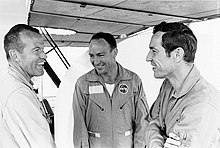
Cooper was selected as backup Commander for the May 1969 Apollo 10 mission. This placed him in line for the position of Commander of Apollo thirteen, according to the usual crew rotation procedure established by Slayton as Director of Flight Coiffure Operations. However, when Shepard, the Chief of the Astronaut Role, returned to flight status in May 1969, Slayton replaced Cooper with Shepard as Commander of this crew. This mission after became Apollo 14 to give Shepard more time to train.[2] [64] Loss of this command placed Cooper further downwardly the flight rotation, meaning he would non fly until one of the after flights, if always.[65]
Slayton declared that Cooper had developed a lax attitude towards training during the Gemini plan; for the Gemini five mission, other astronauts had to coax him into the simulator.[66] Even so, according to Walter Cunningham, Cooper and Scott Carpenter were the only Mercury astronauts who consistently attended geology classes.[67] Slayton later asserted that he never intended to rotate Cooper to another mission, and assigned him to the Apollo 10 backup coiffure merely because of a lack of qualified astronauts with control experience at the fourth dimension. Slayton noted that Cooper had a slim chance of receiving the Apollo xiii command if he did an outstanding task every bit backup commander of Apollo x, but Slayton felt that Cooper did not.[68]
Dismayed by his stalled astronaut career, Cooper retired from NASA and the USAF on July 31, 1970, with the rank of colonel, having flown 222 hours in infinite.[ii] Presently after he divorced Trudy,[69] he married Suzan Taylor, a schoolteacher, in 1972.[69] They had two daughters: Colleen Taylor, built-in in 1979; and Elizabeth Jo, born in 1980. They remained married until his death in 2004.[70]
Later life [edit]
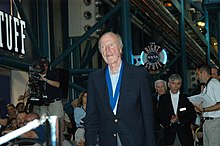
Cooper at an induction anniversary of the U.S. Astronaut Hall of Fame in 2004. Astronauts John Immature and Cistron Cernan stand behind him.
After leaving NASA, Cooper served on several corporate boards and as technical consultant for more than a dozen companies in fields ranging from loftier performance gunkhole design to energy, construction, and shipping design.[58] Between 1962 and 1967, he was president of Operation Unlimited, Inc., a manufacturer and distributor of racing and marine engines, and fiberglass boats. He was president of GCR, which designed, tested and raced championship cars, conducted tire tests for race cars, and worked on installation of turbine engines on cars. He served on the lath of Teletest, which designed and installed advanced telemetry systems; Doubloon, which designed and built treasure hunting equipment; and Cosmos, which conducted archeological exploration projects.[58]
Every bit part owner and race project manager of the Profile Race Team from 1968 to 1970, Cooper designed and raced high performance boats. Between 1968 and 1974 he served equally a technical consultant at Republic Corp., and Full general Motors, Ford and Chrysler Motor Companies, where he was a consultant on design and construction of various automotive components. He was besides a technical consultant for Canaveral International, Inc., for which he developed technical products and served in public relations on its land development projects, and served on the board of directors of APECO, Campcom LowCom, and Crafttech.[58]
Cooper was president of his own consulting firm, Gordon Cooper & Associates, Inc., which was involved in technical projects ranging from airline and aerospace fields to land and hotel development.[58] From 1973 to 1975, he worked for The Walt Disney Company as the vice president of inquiry and development for Epcot.[58] In 1989, he became the chief executive of Galaxy Group, Inc., a visitor which designed and improved pocket-sized airplanes.[71] [72]
UFO sightings [edit]
In Cooper's autobiography, Leap of Religion, co-authored with Bruce Henderson, he recounted his experiences with the Air Forcefulness and NASA, along with his efforts to expose an declared UFO conspiracy theory.[73] In his review of the book, space historian Robert Pearlman wrote: "While no ane can debate with someone'due south experiences, in the example of Cooper's ain sightings, I institute some difficulty understanding how someone then connected with ground breaking engineering science and science could easily embrace ideas such as extraterrestrial visits with little more than anecdotal testify."[74]
Cooper claimed to have seen his first UFO while flight over West Germany in 1951,[75] although he denied reports he had seen a UFO during his Mercury flight.[76] On May 3, 1957, when Cooper was at Edwards, he had a crew gear up up an Askania Cinetheodolite precision landing system on a dry lake bed. This cinetheodolite arrangement could take pictures at thirty frames per second as an aircraft landed. The crew consisted of James Bittick and Jack Gettys, who began work at the site just earlier 08:00, with both still and movie cameras. Co-ordinate to Cooper's accounts, when they returned later that morning they reported that they had seen a "strange-looking, saucer-like" shipping that did non make a sound either on landing or take-off.[77]
Cooper recalled that these men, who saw experimental shipping on a regular basis as part of their job, were clearly unnerved. They explained how the saucer hovered over them, landed 50 yards (46 m) away using 3 extended landing gears, and and then took off every bit they approached for a closer look. He called a special Pentagon number to call to written report such incidents, and was instructed to have their film developed, but to brand no prints of it, and transport it in to the Pentagon right away in a locked courier pouch.[78] As Cooper had non been instructed to not look at the negatives before sending them, he did. Cooper claimed that the quality of the photography was excellent, and what he saw was exactly what Bittick and Gettys had described to him. He expected that there would exist a follow-up investigation, since an shipping of unknown origin had landed at a classified military installation, just never heard about the incident again. He was never able to track down what happened to those photos, and assumed they ended upward going to the Air Forcefulness's official UFO investigation, Project Blueish Volume, which was based at Wright-Patterson Air Force Base of operations.[78]
Cooper claimed until his death that the U.South. government was indeed roofing up information virtually UFOs. He pointed out that there were hundreds of reports made by his boyfriend pilots, many coming from military machine jet pilots sent to respond to radar or visual sightings.[42] In his memoirs, Cooper wrote he had seen unexplained aircraft several times during his career, and that hundreds of reports had been made.[42] In 1978 he testified before the United nations on the topic.[79] Throughout his later life Cooper repeatedly expressed in interviews that he had seen UFOs, and described his recollections for the 2003 documentary Out of the Blue.[42]
Death [edit]
[80] Cooper died at age 77 from centre failure at his dwelling in Ventura, California, on October 4, 2004. Cooper was the final American to have flown a solo mission in space until, on June 21, 2004, Mike Melvill piloted SpaceShipOne to an altitude of 100.ane kilometers (62.2 mi) on its first spaceflight.[81] [70]
A portion of Cooper'due south ashes (along with those of Star Trek role player James Doohan and 206 others) was launched from New Mexico on April 29, 2007, on a sub-orbital memorial flying by a privately endemic UP Aerospace SpaceLoft Forty sounding rocket. The capsule conveying the ashes fell dorsum toward Earth as planned; it was lost in mountainous landscape. The search was obstructed past bad weather, but after a few weeks the capsule was constitute, and the ashes it carried were returned to the families.[82] [83] [84] The ashes were then launched on the Explorers orbital mission on August 3, 2008, just were lost when the Falcon one rocket failed ii minutes into the flying.[84] [85]
On May 22, 2012, another portion of Cooper'southward ashes was among those of 308 people included on the SpaceX COTS Demo Flight 2 that was leap for the International Space Station.[84] This flying, using the Falcon nine launch vehicle and the Dragon capsule, was uncrewed. The 2d phase and the burying canister remained in the initial orbit that the Dragon C2+ was inserted into, and burned up in the Earth's atmosphere a month later on.[86]
Awards and honors [edit]
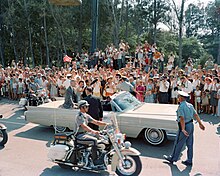
Cooper at a parade given in his honor
Cooper received many awards, including the Legion of Merit, the Distinguished Flying Cross with oak foliage cluster, the NASA Exceptional Service Medal, the NASA Distinguished Service Medal, the Collier Bays,[87] the Harmon Bays, the DeMolay Legion of Honor, the John F. Kennedy Trophy,[58] the Iven C. Kincheloe Honour,[88] the Air Forcefulness Association Trophy, the John J. Montgomery Award, the General Thomas D. White Trophy,[89] the Academy of Hawaii Regents Medal, the Columbus Medal, and the Silver Antelope Award.[58] He received an honorary D.Sc. from Oklahoma Land Academy in 1967.[58]
He was one of five Oklahoman astronauts inducted into the Oklahoma Aviation and Space Hall of Fame in 1980.[90] He was inducted into the International Infinite Hall of Fame in 1981,[71] [91] and the U.S. Astronaut Hall of Fame on May 11, 1990.[92] [93]
Cooper was a member of the Club of Experimental Examination Pilots, the American Institute of Aeronautics and Astronautics, the American Astronautical Society, Scottish Rite and York Rite Masons, Shriners, the Regal Order of Jesters, the Rotary Club, Order of Daedalians, Confederate Air Forcefulness, Adventurers' Society of Los Angeles, and Male child Scouts of America.[58] He was a Master Mason (member of Carbondale Lodge # 82 in Carbondale, Colorado), and was given the honorary 33rd Caste by the Scottish Rite Masonic trunk.[94]
Cultural influence [edit]
Cooper's Mercury astronaut career and highly-seasoned personality were depicted in the 1983 film The Right Stuff, in which he was portrayed by Dennis Quaid. Cooper worked closely with the product company, and every line uttered by Quaid was reportedly attributable to Cooper's recollection. Quaid met with Cooper before the casting call and learned his mannerisms. Quaid had his hair cut and dyed to match Cooper'southward appearance in the 1950s and 1960s.[95]
Cooper was later portrayed by Robert C. Treveiler in the 1998 HBO miniseries From the Earth to the Moon, and by Bret Harrison in the 2022 ABC TV series The Astronaut Wives Club. That twelvemonth, he was also portrayed by Colin Hanks in the Season 3 episode "Oklahoma" of Drunk History, written by Laura Steinel, which retold the story of his Mercury-Atlas 9 flight.[95]
While he was in space, Cooper recorded dark spots he noticed in the waters of the Caribbean. He believed these anomalies may be the locations of shipwrecks. The 2022 Discovery Channel docu-series Cooper's Treasure followed past Darrell Miklos as he searched through Cooper's files to observe the location of the suspected shipwrecks.[96] [97]
Cooper appeared as himself in an episode of the goggle box series CHiPs, and during the early on 1980s fabricated regular telephone call-in appearances on chat shows hosted by David Letterman, Merv Griffin and Mike Douglas. The Thunderbirds character Gordon Tracy was named after him. He was also a major contributor to the book In the Shadow of the Moon (published later his death), which offered his concluding published thoughts on his life and career.[98]
In 2019, National Geographic began filming a tv series based on Tom Wolfe'due south 1979 book The Right Stuff. Colin O'Donoghue is portraying Gordon Cooper. While the serial was set to air in leap of 2020,[99] the first two episodes aired on October nine, 2020, on subscription service Disney+.
The 2022 series For All Mankind (Telly serial) has Gordon "Gordo" Stevens, a character based in office on him.
Notes [edit]
- ^ Burgess 2011, p. 336.
- ^ a b c d eastward f g h Greyness, Tara. "L. Gordon Cooper Jr". 40th Anniversary of Mercury 7. NASA. Retrieved July 10, 2015.
- ^ Cooper & Henderson 2000, pp. 93–94.
- ^ a b c d e f chiliad Burgess 2011, p. 337.
- ^ a b c Cooper & Henderson 2000, p. 102.
- ^ "Scouting and Space Exploration". Boy Scouts of America. Archived from the original on March iv, 2016. Retrieved Jan ii, 2018.
- ^ Cooper & Henderson 2000, pp. 94–95.
- ^ a b c Cooper & Henderson 2000, pp. 102–103.
- ^ "Leroy Gordon Cooper, Jr". Veteran Tributes. Retrieved December 30, 2018.
- ^ a b c d Burgess 2016, p. 13.
- ^ Burgess 2016, p. fourteen.
- ^ Cooper & Henderson 2000, pp. 7–10.
- ^ Cooper & Henderson 2000, pp. 12–xv.
- ^ Slayton & Cassutt 1994, p. 73.
- ^ Burgess 2016, pp. 23–24.
- ^ Burgess 2011, pp. 274–275.
- ^ Atkinson & Shafritz 1985, pp. 42–47.
- ^ Cooper & Henderson 2000, pp. 22–23.
- ^ Burgess 2016, p. 34.
- ^ Cooper et al. 2010, pp. 83–85.
- ^ Cooper & Henderson 2000, pp. 24–25.
- ^ Wolfe 1979, pp. 152–153.
- ^ Burgess 2016, p. 36.
- ^ a b Thompson 2004, p. 336.
- ^ Cooper & Henderson 2000, pp. 28–30.
- ^ Burgess 2016, p. 47.
- ^ Slayton & Cassutt 1994, pp. 121–122.
- ^ Slayton & Cassutt 1994, p. 122.
- ^ Swenson, Grimwood & Alexander 1966, pp. 486–487.
- ^ a b Swenson, Grimwood & Alexander 1966, pp. 489–490.
- ^ Slayton & Cassutt 1994, p. 127.
- ^ a b Swenson, Grimwood & Alexander 1966, p. 492.
- ^ a b c Cooper & Henderson 2000, pp. 37–39.
- ^ Slayton & Cassutt 1994, p. 129.
- ^ a b Swenson, Grimwood & Alexander 1966, p. 489.
- ^ Swenson, Grimwood & Alexander 1966, p. 497.
- ^ Swenson, Grimwood & Alexander 1966, p. 496.
- ^ Cooper & Henderson 2000, pp. 52–53.
- ^ Wolfe 1979, p. 78.
- ^ Cooper & Henderson 2000, p. 57.
- ^ Cooper & Henderson 2000, pp. 56–57.
- ^ a b c d David, Leonard (July 30, 2000). "Gordon Cooper Touts New Volume Spring of Religion". Infinite.com. Archived from the original on July 27, 2010. Retrieved Jan xx, 2008.
- ^ a b Swenson, Grimwood & Alexander 1966, p. 501.
- ^ Hailey, Foster (May 23, 1963). "Urban center Roars Big 'Well Washed' to Cooper". The New York Times. pp. 1, 26.
- ^ a b Burgess 2016, pp. 204–206.
- ^ Thompson 2004, pp. 343–345.
- ^ a b Slayton & Cassutt 1994, pp. 136–139.
- ^ "From Orbiting The Earth To The Arena of Politics". St. Petersburg Times. Jan eighteen, 1964. Retrieved July 28, 2009 – via The New York Times.
- ^ Hacker & Grimwood 1977, pp. iii–5.
- ^ Hacker & Grimwood 1977, p. 255.
- ^ Cooper & Henderson 2000, p. 113.
- ^ Cooper & Henderson 2000, p. 115.
- ^ a b "'eight Days or Bust' +fifty years: Gemini 5 made history with starting time crew mission patch". collectSPACE. Baronial 24, 2015. Retrieved January 2, 2018.
- ^ French & Burgess 2007, p. 44.
- ^ Hacker & Grimwood 1977, pp. 256–259.
- ^ Hacker & Grimwood 1977, pp. 239, 266.
- ^ a b Hacker & Grimwood 1977, pp. 259–262.
- ^ a b c d e f grand h i j "Gordon Cooper NASA Biography". NASA JSC. October 2004. Archived from the original on December 24, 2018. Retrieved May vii, 2017.
- ^ Burgess 2016, p. 231.
- ^ "Astronaut Goes to Sea". Desert Sun. Vol. 38, no. 78. Nov 3, 1964. Retrieved January 21, 2019.
- ^ Burgess 2016, p. 233.
- ^ "1967 Orange Bowl Regatta". The Vintage Hydroplanes. Retrieved Jan 21, 2019.
- ^ a b Cooper & Henderson 2000, p. 178.
- ^ Shayler 2002, p. 281.
- ^ Cooper & Henderson 2000, pp. 176–182.
- ^ Chaikin 2007, p. 247.
- ^ Cunningham 2009, pp. 42–43.
- ^ Slayton & Cassutt 1994, p. 236.
- ^ a b Cooper & Henderson 2000, p. 202.
- ^ a b Wald, Matthew L. (Oct 5, 2004). "Gordon Cooper, Astronaut, Is Dead at 77". The New York Times . Retrieved July 10, 2015.
- ^ a b "Leroy Thousand. Cooper Jr.: Flew the last Mercury mission, longest of program". New Mexico Museum of Space History. Retrieved January 2, 2019.
- ^ "The Infinite Review: Loss of organized religion: Gordon Cooper's post-NASA stories". The Infinite Review. Retrieved Feb two, 2019.
- ^ Burgess 2016, pp. 341–342.
- ^ "'Faith' regained: Gordon Cooper interview". collectSPACE. Retrieved Jan eight, 2019.
- ^ Cooper & Henderson 2000, p. 81.
- ^ Martin, Robert Scott (September 10, 1999). "Gordon Cooper: No Mercury UFO". Infinite.com. Purch. Archived from the original on January 23, 2010. Retrieved January 20, 2008.
- ^ Cooper & Henderson 2000, pp. 82–83.
- ^ a b Cooper & Henderson 2000, pp. 83–86.
- ^ Bond, Peter (November 18, 2004). "Col Gordon Cooper". Independent. London. Retrieved October iii, 2010.
- ^ Schwindt, Oriana (Apr 18, 2017). "This astronaut establish sunken treasure from space and kept it hush-hush until his deathbed". VICE News. Retrieved February 2, 2019.
- ^ Torgan, Andrew (Oct 2, 2014). "Making History with SpaceShipOne: Airplane pilot Brian Binnie Recalls Historic Flight". Space.com . Retrieved November 28, 2019.
- ^ "Ashes of "Star Trek's" Scotty found after space ride". Reuters. May 18, 2007. Retrieved Jan 20, 2008.
- ^ Sherriff, Lucy (May 22, 2007). "Scotty: ashes located and heading home". The Register . Retrieved January 20, 2008.
- ^ a b c "Pioneering astronaut's ashes ride into orbit with trailblazing private spacecraft". collectSPACE. May 22, 2012. Retrieved January 2, 2019.
- ^ Bergin, Chris (Baronial ii, 2008). "SpaceX Falcon I fails during kickoff stage flight". NASASpaceflight.com . Retrieved January 2, 2019.
- ^ "FALCON 9 R/B – Satellite Information". Heavens To a higher place. Retrieved January 2, 2019.
- ^ "Astronauts Take Their Twenty-four hour period at the White Firm". Chicago Tribune. Chicago, Illinois. October 11, 1963. p. iii – via Newspapers.com.
- ^ Wolfe, Tom (October 25, 1979). "Cooper the Cool jockeys Faith 7—between naps". Chicago Tribune. p. 22 – via Newspapers.com.
- ^ "Cooper Gets White Trophy For U.South. Air Accomplishment". The New York Times. September 22, 1964. p. 21.
- ^ "State Aviation Hall of Fame Inducts 9". The Daily Oklahoman. Oklahoma City, Oklahoma. December 19, 1980. p. 2S – via Newspapers.com.
- ^ Harbert, Nancy (September 27, 1981). "Hall to Induct Seven Space Pioneers". Albuquerque Periodical. Albuquerque, New Mexico. p. 53 – via Newspapers.com.
- ^ "L. Gordon Cooper Jr". Astronaut Scholarship Foundation. Retrieved Jan 2, 2019.
- ^ "Mercury Astronauts Dedicate Hall of Fame at Florida Site". Victoria Abet. Victoria, Texas. Associated Press. May 12, 1990. p. 38 – via Newspapers.com.
- ^ "Masonic Astronauts". Freemason Data. March 2015. Retrieved Jan eight, 2019.
- ^ a b Burgess 2016, pp. 273–274.
- ^ "Nigh Cooper's Treasure". Discovery. Retrieved April 29, 2017.
- ^ Bradley, Laura (Apr 17, 2017). "How a NASA Astronaut's Treasure Map Could Make History". Vanity Off-white . Retrieved Feb ii, 2019.
- ^ Burgess 2016, p. 230.
- ^ "'The Right Stuff': Colin O'Donoghue To Star In Nat Geo Series In Recasting". Deadline. Retrieved July 26, 2020.
References [edit]
- Atkinson, Joseph D.; Shafritz, Jay Chiliad. (1985). The Existent Stuff: A History of NASA'south Astronaut Recruitment Program. Praeger special studies. New York: Praeger. ISBN978-0-03-005187-half dozen. OCLC 12052375.
- Burgess, Colin (2011). Selecting the Mercury Seven: The Search for America's First Astronauts. Springer-Praxis books in space exploration. New York; London: Springer. ISBN978-1-4419-8405-0. OCLC 747105631.
- Burgess, Colin (2016). Faith vii: 50. Gordon Cooper, Jr., and the Concluding Mercury Mission. Springer-Praxis books in space exploration. New York; London: Springer. ISBN978-3-319-30562-2. OCLC 1026785988.
- Carpenter, Chiliad. Scott; Cooper, Fifty. Gordon Jr.; Glenn, John H. Jr.; Grissom, Virgil I.; Schirra, Walter M. Jr.; Shepard, Alan B. Jr.; Slayton, Donald K. (2010) [Originally published 1962]. Nosotros Seven: By the Astronauts Themselves . New York: Simon & Schuster Paperbacks. ISBN978-1-4391-8103-4. LCCN 62019074. OCLC 429024791.
- Chaikin, Andrew (2007). A Man on the Moon: The Voyages of the Apollo Astronauts. London: Penguin Books. ISBN978-0-14-311235-8. OCLC 958200469.
- Cooper, Gordon; Henderson, Bruce (2000). Jump of Religion. New York: HarperCollins. ISBN0-06-019416-two. OCLC 59538671.
- Cunningham, Walter (2009) [1977]. The All-American Boys. New York: ipicturebooks. ISBN978-ane-87696-324-8. OCLC 1062319644.
- French, Francis; Burgess, Colin (2007). In the Shadow of the Moon. Lincoln, Nebraska: University of Nebraska Printing. ISBN978-0-8032-1128-5.
- Hacker, Barton C.; Grimwood, James M. (1977). On the Shoulders of Titans: A History of Project Gemini (PDF). Washington, D.C.: National Helmsmanship and Space Administration. SP-4203. Retrieved March xv, 2017.
- Shayler, David (2002). Apollo: The Lost and Forgotten Missions. London: Springer. ISBNane-85233-575-0. OCLC 319972640.
- Slayton, Donald Chiliad. "Deke"; Cassutt, Michael (1994). Deke! U.South. Manned Space: From Mercury to the Shuttle (1st ed.). New York: Forge. ISBN0-312-85503-6.
- Swenson, Loyd S. Jr.; Grimwood, James One thousand.; Alexander, Charles C. (1966). This New Ocean: A History of Project Mercury. The NASA History Series. Washington, DC: National Aeronautics and Infinite Administration. OCLC 569889. NASA SP-4201. Retrieved June 28, 2007.
- Thompson, Neal (2004). Light This Candle: The Life & Times of Alan Shepard, America'southward Offset Spaceman (1st ed.). New York: Crown Publishers. ISBN0-609-61001-5. LCCN 2003015688. OCLC 52631310.
- Wolfe, Tom (1979). The Right Stuff. New York: Farrar, Straus, and Giroux. ISBN978-0-553-27556-8. OCLC 849889526.
-
 This article incorporates public domain material from the National Aeronautics and Space Administration website https://history.nasa.gov/40thmerc7/cooper.htm.
External links [edit]
- Why Did 'Gordo' Tell UFO Stories?
- "Remembering 'Gordo'" – NASA memories of Gordon Cooper
- "LEROY GORDON COOPER, JR. (COLONEL, USAF, RET.) NASA ASTRONAUT (DECEASED)" (PDF). NASA. October 2004. Retrieved January 15, 2021.
Source: https://en.wikipedia.org/wiki/Gordon_Cooper
0 Response to "In Saw Did Gordon Ever Get to See Family Again"
Post a Comment